Reframing Retirement: A Posting, Not A Graveyard - A Case Study of Transition from Military Service to Academia
✍️ Dr M. Anwar Professor, Department of Psychology, Mukabbir University of Science and Technology, Gujrat.
📅 2026-07-03 10:17:57
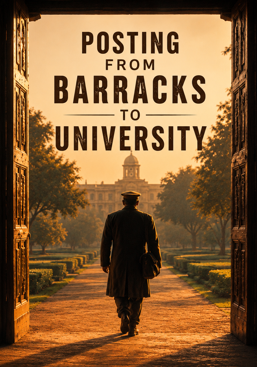
"Arise, for the assembly of the world has a new design now.
From East to West, the beginning of your grand era is here."
(Allama Iqbal- Zarb-e-Kaleem)
Abstract
This case study examines the psychological and practical transition of a retired commissioned Army officer from military service to academic life. The subject experienced acute retirement stress, identity loss, and financial pressure upon retirement in 2015. Through positive religious coping, proactive planning, bridge employment, and generativity, the subject transitioned from crisis to a 25-year second career in academia. The study proposes that retirement be reframed as a “posting change” rather than an end of purpose. Lessons and clinical implications for retirees are discussed.
Case Presentation
The subject retired in 2015 after over twenty years as a commissioned officer in the Pakistan Army. On retirement, he returned to a joint family in his native town (City X, Sindh), with responsibility for 13 dependents. Immediate post-retirement stressors included financial anxiety, loss of occupational identity, and family health issues, including elevated blood pressure in an elder sibling and signs of depression in children.
During doctoral studies at University K, a data analysis error threatened the entire dissertation. The supervisor assessed the project as a “gone case.” The subject reported that the primary fear was not academic failure, but the shame of reporting failure to dependent family members. This reflects “social evaluative threat,” a known stressor linked to cognitive blocks and anxiety.
After two nights of analysis, the error was resolved on the fourth attempt. This event became the turning point. The subject completed the PhD and subsequently served 25 years in academia, progressing from lecturer to Head of Psychology, Dean of Social Sciences, and Director of Academia. He also supervised three PhD students and initiated free counselling services with documented success.
Lessons Learnt from the Case Study
The following lessons are learnt from the case study: -
a. Reframe Retirement as Posting. In the military service, a posting ends, but the mission continues at a new station. Retirement is not termination. It is a change of department from barracks to classroom. The departmental shift redefines the mission (teaching and guidance to the students).
b. Prioritize Faith-Based Coping. Recite “Bismillah” before any operation or act. It strengthens faith in the Creator (Allah SWT) and establishes a spiritual connection. Positive religious coping reduces anxiety and increases resilience during transition.
c. Plan Before Retirement. In military service, mission briefing precedes deployment. Veterans must develop their CVs, improve their skills, and enlist bridge employment options at least 2 to 3 years before their retirement date.
d. Choose Purpose Over Pay. Soldiers reject drudgery and dislike working as conscripts. They serve a mission that enhances their pride. Post-retirement work must align with values and generativity, not only income.
e. Cultivate Zest and Grit. Soldiers' endurance during military service gets strengthened. They work with motivation and keep their spirits high. They stay invested in the completion of their mission. Their perseverance and passion for long-term goals enable them to achieve their goals despite obstacles. On retirement, they must reframe retirement as a posting and not a termination of service. On retirement, many veterans fall prey to stagnation, which produces negative thoughts leading to depression. On retirement, stagnation must be fought with positivity and a sense of optimism.
f. Practice Generativity. In military culture, seniors always train and guide their juniors to achieve the standard of excellence. If retirement is reframed as posting, the retiree will resort to finding ways to teach and guide the younger generation. Erikson’s stage of generativity pointed out that guiding the next generation creates post-retirement purpose. |
Clinical Implications
The case study proffers the following clinical implication: -
aDiagnosis: Acute Retirement Stress Syndrome due to identity disruption and financial pressure.
bIntervention Model: Tawakkul/Faith in Allah, keep the appetite for possible things to happen (Zest), preservation and passion for long-term goals, resilience and commitment to complete the assigned task (Grit), reframing retirement as posting, planning for retirement, taking a teaching job on completion of PhD, and resorting to generativity to redefine the purpose of life.
cOutcome: Transformation from “stressed retiree” to “educator and counsellor.” Evidence includes 25 years of academic service and successful mentorship of doctoral candidates.
Conclusion
Retirement does not test bank balance. It tests the retiree’s first question. If the first question is “How will I face my family?” then the first answer must be framed by purpose and faith. As Iqbal stated, the grand era begins after the barracks. Retirement is not a drying up and should not be considered the end of purpose, leading to a graveyard. It must be reframed as a posting from one department to another.
Author’s Note: All personal names and institutional locations are pseudonyms to protect privacy. The psychological narrative and events are authentic and published with informed consent for public awareness.
References
Dickerson, S. S., & Kemeny, M. E. (2004). Acute stressors and cortisol responses: A theoretical integration and synthesis. Psychological Bulletin, 130(3), 355–391. https://doi.org/10.1037/0033-2909.130.3.355
Duckworth, A. L., Peterson, C., Matthews, M. D., & Kelly, D. R. (2007). Grit: Perseverance and passion for long-term goals. Journal of Personality and Social Psychology, 92(6), 1087–1101. https://doi.org/10.1037/0022-3514.92.6.1087
Erikson, E. H. (1950). Childhood and society (2nd ed.). W. W. Norton & Company.
Iqbal, M. (1936). Zarb-e-Kaleem [The Rod of Moses]. Sheikh Ghulam Ali & Sons.
Pargament, K. I. (1997). The psychology of religion and coping: Theory, research, practice. Guilford Press.
Russell, B. (1930). The conquest of happiness. Liveright Publishing.
Wang, M., & Shi, J. (2014). Psychological research on retirement. Annual Review of Psychology, 65, 209–233. https://doi.org/10.1146/annurev-psych-010213-115131