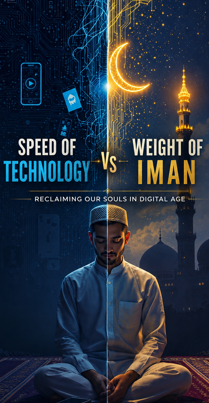
The Speed of Technology vs The Weight of Imaan: Reclaiming Our Souls in the Digital Age
✍️ Dr M. Anwar Professor, Department of Psychology, Mukkabir University of Science and Technology, Gujrat.
📅 2026-07-19 16:58:55
Introduction
Bismillah-ir-Rahman-ir-Raheem
Allah SWT says in *Quran:
"And I did not create the jinn and mankind except to worship Me” (Surah Adh-Dhariyat: 56)
But today, the biggest question is: Are we worshipping Allah, or are we worshipping the algorithm?
No doubt the technology is a blessing from Allah. It connects us, heals us, and teaches us. But when the blessing becomes the master, it becomes a test. I fear we are failing that test.
The speed of technology is now faster than the speed of our wisdom, our faith, and our patience. And this speed is having a deep psychological impact on us, especially on our youth.
1. Fast Answers, Empty Hearts
Today’s generation gets every answer in one second. Unfortunately, they are not diving deep into the reality (haqeeqat) and rationality(hikmat) behind things.
There is no critical thinking (tafakkur), no rationality, no asking "What are the consequences? What does Allah say about this?" Fast decisions and instant reactions result in deep regret.
Imam Al-Ghazali RA said: "Knowledge without action is madness, and action without knowledge is vanity."
We are collecting information, but we have lost wisdom.
2. From "Sadaqah Jariyah" to "Disposable Life"
Companies launch a new phone every six months, and we throw away the old one. This mindset of disposability has entered our homes.
If a relationship is difficult, we break it. If a job is hard, we leave it. If worship takes time, we shorten it.
Allah says: "And be not like she who untwisted her spun thread after it was strong" (Surah An-Nahl: 92)
Allah teaches us durability, patience, and commitment. Technology is teaching us the opposite.
3. Prayers Turned into Notifications
Even our connection with Allah has become a shortcut. We rush through prayer (salah). We close the dua quickly. We have no time for long prostration (sujood), crying in midnight prayers (tahajjud) for sitting with the Quran.
Unfortunately, our body is in the mosque (masjid), but our mind is on Instagram.
Prophet Muhammad ﷺ said: "The coolness of my eyes has been made in prayer."
When prayer becomes a burden instead of a coolness, we know our heart is sick.
4. "Me First" Culture: The Death of Adab and Sabr
Young adults have no tolerance. Every stimulus gets an instant reaction. No pause. No second thought.
This hurry has led to emotional decisions, court marriages, and record-breaking divorces.
"Self-promotion" is more important than "system" and "seniors." Respect for elders is at its lowest.
Prophet ﷺ said: "He is not one of us who does not have mercy on our young and does not respect our elders."
Bertrand Russell warned: "A life centered only on the self is a prison."
When "I" becomes bigger than "We" and "Allah", moral degradation is inevitable.
5. Education Has Become Business, Not Training (Tarbiyah)
Our schools and universities are producing degree-holders, not character-builders. We teach skills, but we forget morals (akhlaq).
Corruption is now called "compulsion." Lying is called "smartness." Human values are set aside.
Socrates said: "The unexamined life is not worth living."
Dr. Abdus Salam, our Nobel Laureate, said: "Scientific development is impossible without a spirit of freedom and tolerance."
What is the use of a PhD if the character is a thief?
The Way Forward for Pakistan: 5 Steps From "Fuse Bulb" to "Noor" (Enlightenment)
Allah has not left us. The cure is in returning to purpose.
1. Teach "Tafakkur" (Meditation) in Schools and Colleges
Make "Seerah, Philosophy & Ethics" compulsory. Teach children to pause, to ask why, and to think of consequences before acting.
Kant said: "Act only by that rule which you can wish to become a universal law."
2. Build "Impersonal Interests" - Live Beyond Yourself.
Make at least two (2) credit hours of community service and mentorship mandatory for every university student. Connect them to orphans, to patients, to the elderly.
Russell said: "The secret of happiness is to have interests as wide as possible and reactions as friendly as possible." When you live for others, your own pain becomes small.
3.* Reclaim the Depth of Ibadah (worship)*
Imams and scholars must talk about "Digital Ethics" in Friday sermons. Parents must create "No Phone Zones" during salah and family time.
Remember: Allah does not need our prayer. We need it. It is a charger that recharges our batteries.
4. Revive the Sanctity of Family and Respect.
Government and media must run campaigns for marriage preparation, conflict resolution, and "Adab (respect) of Elders."
Allah says: "And lower to them the wing of humility out of mercy" (Surah Al-Isra: 24).
1. De-Commercialize Education. Re-Spiritualize It.
HEC must link 30% of university funding to "Character and Service Output." Reward institutions that produce honest, patriotic, and God-conscious citizens, not just toppers.
Conclusion: Who Will Be the Light? *
Dear students, colleagues, and friends! Technology is a tool. A lamp can light a room or it can start a fire. It depends on the hand that holds it.
The philosophers were slow, but they gave us direction. The Prophets were patient, but they changed the world.
Do not let the speed of your device kill the depth of your soul.
Do not become a "fuse bulb" waiting for NADRA’s death certificate.
Become an "LED of Noor" whose light does not die, because its power source is Allah and service to His creation.
"And whoever relies upon Allah - then He is sufficient for him" (Surah At-Talaq: 3).
Let us use technology to build, to teach, to heal, and to get closer to Allah.
That is the higher goal. That is the specific purpose.
Wama Tawfiqi Illa Billah
References
1. Al-*Quran
2. Prophet Muhammad (PBUH)
3. Bertrand Russell - The Conquest of Happiness, The Problems of Philosophy
4. Immanuel Kant - Groundwork of the Metaphysics of Morals
5. Aristotle - Nicomachean Ethics - Concept of Eudaimonia & Virtue
6. Imam Al-Ghazali - Ihya Ulum al-Din - On Tazkiyah and Knowledge
7. Peter Singer - The Life You Can Save - On Effective Altruism
8. Dr. Abdus Salam - Speeches on Science, Ethics and Pakistan